Sophie. The Shop. And Silver.

[5 minute read]

On her way to work Sophie showed up for her planned brunch with Ma. She has been working at the wool-weaving shop, steadily for 12 moons. Before she completed her studies 8 moons ago, she would leave tutoring, and work from midday to sundown.

At her young adult age, she was promised consideration for a promotion to be the candlelight shift supervisor. That was 4 moons ago. A poor imperial harvest has been depressing trade, so the shop is in straits. But a friend who coordinates the shop’s staffing is still optimistic. Ma periodically inquires gently if she has heard anything from him. Not yet.

Working at the shop was killing her soul. At least that is what “everyone” thought, because she complained persistently about the mediocre management and unmotivated coworkers who made extra work for her. And she also complained about all her elders who told her what she “should” and “could” be doing, as a privileged daughter of the landed class.

She had been planning to seek more gainful labor elsewhere, and four moons ago, inquired with several other proprietors. Only one invited her to interview.

As for Ma, through all this, she tried to let her natural love for a daughter flow out of her, by believing in her daughter, and not trying to fix or solve: Unconditional belief is the form of love known as faith. Other elders in Sophie’s life were already urging her to be more ambitious, at least as they see ambition. But Sophie was doing life her way.

Since her second year of tutoring, Sophie has gone from an overachiever wanting political grooming at the academy, to lower aspirations as a skilled tradesperson through apprenticeship with a guild, but is now a mere second-shift weaver at the shop. She still has aspirations to make more silver so she can lease a flat inside the city walls, where her restlessness suspects unknown freedoms. She has wanted that for a long time, but hasn’t had the coin.

Ma’s circle have offered supportive advice for mothering Sophie more firmly, about her ambitions and a life plan. Ma has not yet felt the gods move her to action. These associates and relatives have genuine affection for Sophie, so are troubled by the downward spiral of her spirit. Sophie complains privately to Ma that the paths these patrons endorse are not for her.

Ma sees her daughter’s heart with tender clarity. Like the well-wishers, Ma had strongly urged Sophie to reverse her declining ambitions. But Ma withdrew her voice from that chorus moons ago. Her vision sees Sophie’s heart judging herself harshly enough. It would do little good for Ma to pile on. By the grace of the gods, Ma’s hands are now clean on that count. Her tongue has been checked by a growing awareness of judgmentalism’s damage.

Sophie knows that her Ma is an educated lady and prefers she go to academy. Ma feels like a strong enough mother that she doesn’t need to repeat where she stands on things that stab Sophie’s heart. Sophie’s head is much thicker than her heart:-)

Ma has raised Sophie through 20 seasons, cultivating the patience to bear parental insecurities. Each time life bruised Sophie, Ma was her refuge. So Ma remains content to let Sophie’s well-wishers bruise her. In fact, Ma is herself encouraged by the confidence these patrons have in Sophie’s potential. They soothe her own insecurities about whether Sophie’s path will yield fulfillments.

Sophie is a young woman now. And her mother is a woman. Hardheaded free women like them must learn life’s lessons for themselves, earning their wisdom with tenacity that sticks.

One lesson that isn’t hard to learn is how to judge one’s self more strictly than anyone else—or Jupiter Himself.

“Everyone” thinks working at the shop is killing Sophie’s soul…

***

Ma cosigned a loan for Sophie’s wagon last season. The moneylender offered a three-year payback term. Sophie opted for one year, and has made all the payments herself.

Not once has she dodged her work shift for irresponsible frolicking with friends. Not once has she been late to the shop.

Her frustrations with her coworkers are rooted in her own strong sense of responsibility and work ethic. Everyone else in the world may want her to apply that ethic differently, but she is her own woman. She aspires to management. She doesn’t fear leadership. She is merely youthfully impatient about the importance of example-setting by a leader. Perhaps her elder loom-staffing friend sees that too.

Her aspirations are materialistic—-there is no mistaking that. But, she is not immorally procuring the silver she idolizes; she’s earning it. She is frustrated that she can’t get enough, fast enough. That is an instructive frustration. Her next move could be progress on that front. Or the move after that.

Ma earned an academy diploma. That’s her familiar path, so her voice readily joins the chorus who revere it. But her parental vocation now demands wisdom about caveats on any path.

“Everyone” thought working at the shop was killing Sophie’s soul. Ma used to also. But Ma is open to the possibility that, on the contrary,… Well… Just maybe… The contrary.

***

“By the grace of the gods” Ma has kept her hands clean from piling on judgment and making Sophie feel worse about herself. What form has that grace taken?

It’s hard to put words around something so intangible. Recent transitions in Ma’s life have forced her onto a transformative path in search of her truer self. Her soul. A few of the guiding questions she latched onto are: What are my core values? What are my core competencies? What am I passionate about? What good am I good at?

Answers to that question (it’s really all one question to Ma) have sure as hell been more elusive than she anticipated. She’s now resigned that fully satisfying answers may remain mysterious this side of Elysium. One answer that came easily and quickly has been affirmed, confirmed, and reaffirmed by all her beloved friends and family whom she trusts with her life. Rather than wax profound, we’ll end where we started…

The daughter in whom Ma believes, and for whom she has love without conditions, stopped in for brunch today on her way to work…

***

Sequel: Dark Night of the Soul (7) – A SOPHIE sequel: Mirabai Starr’s “Yes” in parenting

Neil D. 2020-04-21
Pandemic Conspiracy Theory of The New World Order Cabal

In response to Pandemic. Narrow Vision, a dear friend reflected:

“Some think Bill Gates is connected to this ‘new world order’ where we become one people ruled by one leader, probably from the US. There’s a conspiracy theory that this virus was no mistake and that what looks very much like generosity to the eye may very well be a new plan of world Government control.”

When it comes to a conspiracy theory, “I’ll believe it when I see it.”

I’m inclined to see how corrupt leaders have lined pockets by fomenting war. But many individual evils don’t amount to a globally planned and coordinated evil, to me.

Carl Jung might say conspiracy theories resemble potent dark archetypes that appeal to our collective unconscious.

One out of 1000 are actually true — let’s say — and that distorts our visions of the other 999. I dump them in the same bucket as unreal reality TV, and the common non-sense of common sense.

If, on your life’s journey, you’ve reached some point of self honesty — rather than ego inflation — I’d trust your vision. Was George Bush II a goofball? Yeah. Was Barack Obama a good guy? Yeah. Is Donald Trump a good guy? No. Is Bill Clinton a mixture of both? Yeah.

Jordan Peterson paraphrases Carl Jung,

“Beware of wisdom not earned.”

Peterson, contends that there is grave vulnerability in naïveté, and those who have not probed and faced the darkness potential in every single human soul are naive positivists. The most reputable sages in our history concur that life is suffering. To pretend otherwise is psychological denial.

The truth is most often what it appears to be, when seen through the eyes of truthful people who are not Petersonianly naive. Satan only posits sheep in wolves’ clothing for those who repress wolves into the unconscious of their Jungian Shadows and deny the daunting imperative to face them.

Pandemic. Narrow Vision


[4 minute read]

I live a block from a Carnegie public library whose namesake wrote, “The man who dies rich dies disgraced.” Bill Gates prophesied a pandemic for which we are woefully prepared and has put his money where his mouth is, stewarding his fortune to address global suffering, including this pandemic.

The stewardship of wealth by titans is merely the most collectively visible reminder of the power of individual persons. Responsible stewardship by moguls is their “giving back” to the persons who collectively enabled their wealth. It’s their self-emptying from atop humps on camels which face needle eyes (or ropes or Gates, if you prefer; see).

Carnegie lived through the Civil War and The Spanish-American war, and was frustrated by the hypocritical lip service of US presidents to global peace—dialogs entertained for the sad purposes of campaign finance messes that continue to plague us a century later, according to at least one reputed historian indicts these presidents as war mongers. Carnegie was left to attempt global diplomacy largely on his own. World War I followed. And the unspeakable horrors of the 20th century ensued:

He was very much a “fool for peace.” His legacy is the notion that civilized people should not consider war inevitable but, rather, an aberration to be abolished. He was a “possibilist,” not a realist. We need more such [people]… willing to dream of a better world and to do what they can to bridge the gap between the present and that better future they envision.

Not too long after Teddy Roosevelt betrayed Carnegie, his fifth cousin lamented:

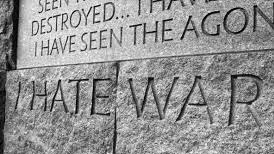
I have seen war… blood running from the wounded… the dead in the mud. I have seen cities destroyed… children starving. I have seen the agony of mothers and wives. I hate war.

His 1936 lamentations engraved in the granite of the FDR Memorial in the US capital today

As we consume sweeping epic news stories about the pandemic, let’s remember that the agony and death are happening to individual human persons.

FDR’s hatred was penned half a decade before the US entered World War II. Half a decade before today’s pandemic, Bill Gates prophesied about our unreadiness for a pandemic in a TED Talk. He put his money where his mouth was even before that prophecy, and continues to do so, marshaling human resources to complement governmental, academic, and private corporate cooperation.

It’s easier to tell and hear the story of one person than of so many heroic persons. But Gates’ generosity has no meaning without single persons translating it into transcendent goodness. If we keep our global vision integrated with a narrowed local vision, this historical event can deeply touch both our personal and collective souls.

The call to social distancing etc. is a cosmically potent prophecy about thinking globally and acting locally: A virus has no respect for sequestered material wealth. Each individual person is vulnerable, and has a responsibility to the collective of humanity—because each person has intrinsic, divine worth by virtue of inestimable value, power, and therefore responsibility. We are all Spider-Mans.

The nobility of “first responders” now includes souls in the food industry and grocery stores. The unspeakable horrors of the 20th century have not entirely drawn our collective attention. At the dawn of the 21st-century, nearly 2 decades ago, horrors above central Pennsylvania, at the Pentagon, and in New York City produced tangible legacies in US society. Little motivates transformation more than the tragedy of deep suffering. As it is for individuals, so it is for a civilization.

Be a first responder to your sister, brother, child, parent… neighbor, grocery bagger, nurse assistant… stranger who walks past six feet away… We are persons before we are a people.

This mystery of paradox is this pandemic’s message:

Vulnerability and power are two sides of the same coin.

By honoring the infinite worth of each person we encounter, we honor our own divine spark within—vulnerable and powerful.

.

[Tomorrow, related,Pandemic. Mother Earth’s Dark Night of the Soul.” TapNotify me of new posts via email.at the end of this page to receive an email when it’s posted. In the meantime, a first response: Pandemic Conspiracy Theory of The New World Order Cabal]

.


A pop artist’s search


[some liberty with an artist’s creation]

I’ve been searching for something sacred I lost, taken out of my soul. We all start in the streams, we’re all carried along, through the desert of truth, we all end in the ocean. I don’t know why I go walking at night; now I’m tired and I don’t want to walk anymore. I hope it doesn’t take the rest of my life until I find what I’ve been looking for. I’m not sure about a life after this; God knows I’ve never been a spiritual man. I know I’m searching for something so undefined that it can only be seen by the eyes of the blind. Something I’d never lose, somebody stole.

Source: Surprise! Official. | Live, release tour. | Live, more contemporary (15 yrs later), electric spontaneity.

Pandemic Prophecies


A wholly secular, scientific viral TED talk by an epidemiologist (here) notes that more pandemics lie ahead, and a dimension of essential preparedness is the fortification of healthcare systems in under-developed nations by aid from the wealthier “unto the least of our brethren,” five years after Bill Gates’ prophetic TED Talk was preceded by more than a decade with the warning of Stan Lee’s Spider-Man that, “With great power comes great responsibility” (Uncle Ben, or another, or centuries earlier). Then there’s the all-time best-seller, millennia earlier:

When I was sick, you visited me.
Whatsoever you do to the least of my people,
That you do unto me.
Now enter into the home of my father.

That amalgamation comes from the song below, which was inspired by verses 31 ff of Mt 25, the chapter before The Passion begins (fuller verses below song material):

‘For I was sick and you visited me’… ‘Lord, when did we see thee sick and visit thee?’ ‘Truly, as you did it to one of the least of these my brethren, you did it to me. Come, inherit the kingdom prepared for you from the foundation of the world.’*

Whatsoever You Do

(below lyrics to this song by Willard “Fr. Bill” Jabusch [1930-2018] are links to various online videos of it. See also)

When I was hungry you gave me to eat
When I was thirsty you gave me to drink
When I was homless you opened your door
When I was naked you gave me your coat
When I was weary you helped me find rest
When I was anxious you helped calm all my fears
When I was laughed at you stood by my side
When I was happy you shared in my joy
Now enter into the home of my father
Whatsoever you do to the least of my people
That you do unto me

Professionally recorded children’s choir + adult female soloist

Professionally recorded male vocalist, piano + acoustic guitar

S. Sudanese childrens chorus and men, a cappella + percussion

Professional instrumental-only

Ecclesial organ choir bootleg

Contemporary instrumentation, male soloist

A humble and simple version

Ecclesial bootleg

Contemporary male choir


Matthew 25:31-end(46), the chapter of Mt before The Passion begins.

34… ‘Come, O blessed of my Father, inherit the kingdom prepared for you from the foundation of the world; 35 for…36… I was naked and you clothed me, I was sick and you visited me, I was in prison and you came to me.’ 37…’Lord, when did we see thee hungry and feed thee, or thirsty and give thee drink? 38 And when did we see thee a stranger and welcome thee, or naked and clothe thee? 39 And when did we see thee sick or in prison and visit thee?’ 40… ‘Truly, I say to you, as you did it to one of the least of these my brethren, you did it to me.’*

Excerpted from:

31 “When the Son of man comes in his glory, and all the angels with him, then he will sit on his glorious throne. 32 Before him will be gathered all the nations, and he will separate them one from another as a shepherd separates the sheep from the goats, 33 and he will place the sheep at his right hand, but the goats at the left. 34 Then the King will say to those at his right hand, ‘Come, O blessed of my Father, inherit the kingdom prepared for you from the foundation of the world; 35 for I was hungry and you gave me food, I was thirsty and you gave me drink, I was a stranger and you welcomed me, 36 I was naked and you clothed me, I was sick and you visited me, I was in prison and you came to me.’ 37 Then the righteous will answer him, ‘Lord, when did we see thee hungry and feed thee, or thirsty and give thee drink? 38 And when did we see thee a stranger and welcome thee, or naked and clothe thee? 39 And when did we see thee sick or in prison and visit thee?’ 40 And the King will answer them, ‘Truly, I say to you, as you did it to one of the least of these my brethren, you did it to me.’*


* Revised Standard Version, Second Catholic (or Ignatius) Edition (RSV-2CE), online.