Dark Night of the Soul (6) – Dad & His Family. Ours


[6 minute read]

My dad once mused about which of his 6 kids he loved most: “Whichever one needs it most in the moment.” (I just choked up writing that, like I do every time its memory rises up unbidden.)

In midlife, by a circuitous journey barely just begun — or as old as I — or unknowably older, I’ve stumbled back into that nugget, having tried a few less durable rules of living, like, “One day at a time,” and others.

I wonder how he got so smart.

Do you think he thought it through? I do, but not in his brain. Through his heart. Not by thinking; by living, acting. Responding to whichever grace was put in his face. His mind was plenty capable of profound thought and communication, but methinks his heart was so very much larger.

He was a large man in the second half of his life. He loved his food like he loved his children—-whatever was in front of him at the moment:-) But that seemed to suit him naturally. He lived hard, deep, wide.

I think he had a big ego, but it too suited him—-not so large that it wasn’t easily carried by the expanse of his soul, perpetually opened to humility by force and by choice. I think his soul received and nourished that buoyancy by living hard, deep, and wide—-sometimes by shame exposed, and sometimes by the inexorable tow of his loved ones splashing into his face the forgiveness he wrestled to bestow on his own fallenness.

His family of origin certainly fed who he was. His brother, sisters, and my cousins still feel like a warm place of palpable love, which would provoke envy if it weren’t swallowed up by gratitude and acceptance unconditional — by that very love itself — reflexively evoked.

His life journey collectively was as turbulent as any child’s of God. I barely know the tip of that iceberg, shared by his own reminiscence, and stories from my mom and his siblings… I wish I spent more time with his family in recent years, regret soothed slightly by a couple feelings…

On the rare occasions I did spend time with them in adulthood, it was as if I had barely grown apart. Of course, I have. They have suffered through so many enormous trials I barely knew about, and likely so very many more I don’t at all. I can barely keep spouses’ names straight, let alone children’s! So, how do I still feel connection?

I spent loads of time with them as a kid, after long rides—-8 of us packed into whatever station-wagon Dad purchased for a paltry pittance that year. Enormous gatherings, with personalities (and bodies!) clashing and mixing, every direction—-a tumult which is the cauldron of love and enduring connection, even if unrecognized until later. Those reunions are a gift perpetually imparted by my dad and his siblings, and by my cousins who all receive it and pour it back out.

It is the intangible gift of a large family. Almost too large. When gathered, everywhere you turn is a different face. A different soul. Interesting to you, as you are to them. Intimacy, forged and enabled by the hugely diminished discomfort largely afforded by virtue of common ancestry. Blood bonds. Virtually no pretense.

Surrounded and crowded by those hearts and faces and souls, there was no need for a conscious choice, nor room for the choice’s anxiety about with whom to engage:
The one in front of you.
In the moment.

The benefits and imprints of large family gatherings needn’t be summoned consciously. Nor do lessons I learned from my father. They were written on my heart as they happened. But it’s nice to have a centralized fountain around which each of those imprints can swim:

“Whichever one needs it most in the moment.”

They may not have been conscious choices. But thankfully, gatherings under God’s shelters don’t rely on your choices alone. God makes some for you, and puts in front of you the face God needs you to encounter, to be God’s cooperator, and recipient. For both you and that other face. For God too.

The forging furnace is the warm hearth of our family’s love, and it’s not as simple as mere necessity in a crowded gathering. It’s not as if the free wills of my dad and his siblings were passive. My mom and he took us to the gatherings, and aunts, uncles, and cousins received us into the inner sanctums of their physical and emotional homes. As an insider in such a family, it takes a little awareness to realize that a tight-knit family is not inevitable. There is sad evidence all around. It takes a devoted and active will to sustain and nourish love so rich. That awareness deepens preciousness.

Here’s a thing that must’ve happened many times, because I carry the memories vaguely, compositely. We kids buzzing about the property—-house sided in white in Bear Creek, or green on Diamond Ave. And where the hell are the adults? Aunts, uncles, and stranger-family who appeared at these events…? All gathered around some table, nibbling on peanuts or those Italian things that would taste like fluffed and crisped paper without the powdered sugar.

What in the hell are those weirdo grown-ups doing, sitting all together? For hours! Talking!! How much could there be to talk about, for crying out loud!? That’s not normal.

No. It’s not. I don’t see it often in other families at all. But I do it with my own siblings. That’s the delayed answer. Sitting together, talking, we are loving. We are forging deeper bonds, at the same time as we extract any needed warmth from that fire. Loving. In the moment. Whatever arises. Whoever needs whatever. Widening our souls, and our family’s as a whole…

Meeting each face our eyes behold. Doing unto the least among us who needs a firey embrace most in the moment.

.
Neil D. (the III!) 2020-05-13
These reflections inspired the 1-minute read, “Dark Night of the Soul (5) – One Simplification

.


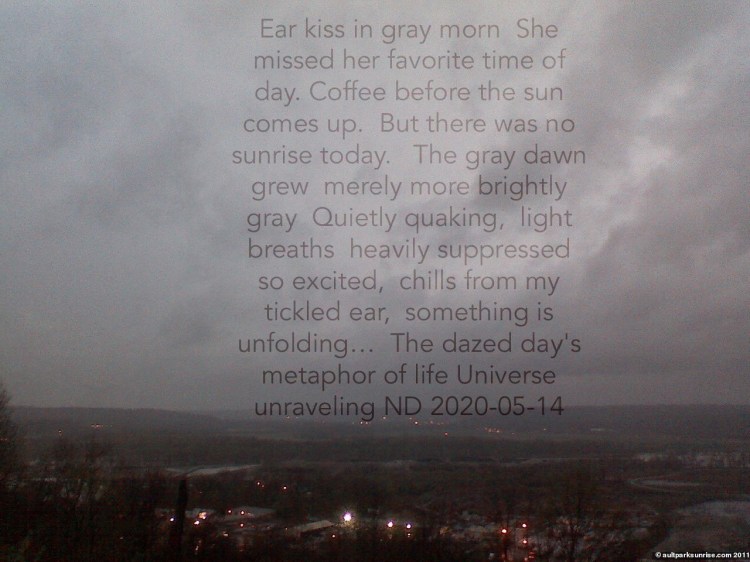
Ear kiss in gray morn

Ear kiss in gray morn

She missed her favorite time of day.
Coffee before the sun comes up.

But there was no sunrise today.

The gray dawn grew
merely more brightly
gray

Quietly quaking,
light breaths
heavily suppressed
so excited,
chills from my tickled ear,
something is unfolding…
The dazed day’s metaphor
Universe unraveling

.
Neil D. 2020-05-14
Dark Night of the Soul (5) – One Simplification


[1 minute read]

Emulate Jesus and the saints? Hard. Why? Where’s the “light burden”?

They served a single child of God at each ‘given’ moment — the singular child their eyes were beholding, at that moment ‘given’ to encounter.

Whatsoever you do to the least of my people… That’s not about an abstract collection of humanity. The face of Christ is not some abstract collective group at which we should aim our love. Don’t be so grandiosely ridiculous. Those exemplars weren’t.

The Christface encounter is one child of God at a time, as we meet that child, in this moment.

I think, as you seek to love each person you encounter throughout your day, you deepen union with the divine within you, meeting your own loving self over and over and over. In the image and likeness of our Origin.

Forget “One day at a time,” or, “Live in the moment,” if you aren’t up to them. Cultivating those habits is no “light burden” either, for the everyday human being. What IS naturally human is relationship. Relate to one Christface at a time. As each comes. As each is given.

We have everything we need. Not for a lifetime. For the moment. A string of which constitutes a lifetime. And beyond.

.

[This brief article is a synopsis of its more expanded predecessor here, for the curious, which incorporates the Dark Night of Sense, omitted above.]

.


Dark Night of the Soul (4) – Introductory Musings: Exemplary Lessons?


[6 minute read]
[see also resource index]
[A shorter 1-minute version of below, extricated from any Dark Night contexts, is here.]

Most narrowly, the phrase originates from a Spanish poem (Dark Night) centuries ago. Its author wrote explications of the poem which speak of two metaphorical nights that purge the soul to approach divine union during this lifetime.

Divine union. That’s a very rare state, exemplified by a rare subset of Saints, and perhaps the most exceptional of spiritual gurus.

I say “perhaps” because it’s a very mystical, abstract notion—-any description of which demands artistic expression like poetic language. It may be the deepest of paradoxes in human experience, alchemically blending suffering and pure joy. After all, “divine union” is a pretty big notion!

If exemplars are extremely rare, how is their experience valuable to the rest of us? The term Christianity presents Christ to us as an exemplar. Every institution which lays claim to that name is inarguably flawed, in no small measure because none is The Exemplar Itself.

Why does it seem so hard to emulate Jesus and Saints? The records say he said, “My burden is light.” It sure doesn’t seem that way to most of us, most of the time, does it? What are we getting so wrong? I think one source of consternation is how poorly the institutions of his name carry the simplicity of his example. They’re obsessed with grandiosities, or with an us-centeredness, or in our otherness versus the divine. In short, the withoutness of sin.

Jesus Christ is a human person, and infinitely more. Divine. The moment we conceive “more,” its meaning evaporates. So, should we seek to emulate the saints who have most fully experienced the dark night, and to emulate Christ? Of course, but their lesson is that those paths lead to evaporation of any intention to emulate.

Ultimate paradox. Seek and ye will will find. Find what? Answers? However unexpected? I don’t think so.

Maybe what we find is that being is seeking; it is not receiving, not finding, but some inaccessible or indescribable mode of being, like (weakly) that eternal among son, father, and spirit?

How “in the hell” could we know?

What we “know” most easily as human beings is our mortality. That’s at some logical spectrum’s opposite of eternity. Christ unifies those opposites, mortal and eternal. Bodily, spiritually, one.

On another abstract spectrum are poles of joy and suffering. Christ unifies those too. Yeshua’s example as exemplar was not to seek *escape* from suffering and find joy. It was to *embrace* suffering and find joy. Undertake the suffering, but don’t be trapped there eternally. Instead, undertake it for the sake of love, and joy will unfold. Not separately, but unified.

Jesus was/is a person. The saints were persons. You and I are persons. Escape from what we are is absolutely NOT the example of these exemplars. Living and being what you are, what I am, what each of them are. A “light burden” must involve that. The good news can’t be only for the saints and spiritually elite, excluding the everyday person.

Don’t lump together, or organize, or institutionalize humanity collectively. Don’t seek to serve all of humankind. Institutions promulgate institutional thinking, and institutions are artifices of the human mind, not divine. God could not be looking at humanity collectively. Christ didn’t. His tradition wasn’t to baptize all humanity at once. One precious person at time. By another precious person. If you’re pursuing a rule of living — some mindset or practical guide — that does not plumb that profound mystery to its deepest depths, you’re chasing air.

Each exemplar served an individual at a time—-one child of God at a time. They quashed false grandiosity by responding to the call to love — at each ‘given’ moment — the singular child their eyes were beholding, at that moment ‘given.’ Not all of humanity. In fact never even the whole life of one individual. In fact, NO part of one person’s life except for the very moment.

Whatsoever you do to the least of my people… That’s not about an abstract collection of humanity. The face of Christ is not some abstract group at which we should seek to aim our love. You can’t develop any plan for how to act in a future that never comes. Only successive moments come, the future never.

The Christface is in one child of God at a time, as we meet that child, in this moment.

And sometimes, at a moment, that child is within; you too are God’s child. Follow the exemplars’ examples and love your own self. Hard? Let the purgation begin.

Suffering and joy… They are one. When you wrestle with them to separate them in your mind, you lose every time. They are you. Both. And, you are already divine. All in this moment.

The joy and suffering you carry will NOT resolve in any future. Stop pretending it can, and love the one you’re with now, even — and perhaps especially — if that one is merely you. Merely you? There’s no “mere” about you, or anyone else. And this is one way to conceive a dark night’s purpose.

When the night of the senses strips away your fantasies about your being “merely” your sensations and futile thoughts of resolving suffering with some grandiose plan… You’re left with a naked you. And ridiculously, you run away from you, back to less profound states of feeling and thinking. Unresolved.

Neither you nor anyone else will see you as all you are, in your divine power and glory, unless you are naked, and little by little, begin to act, content with your nakedness. Then, as that proceeds, your true clothing fits you much more naturally, so you need not don an artificial persona to present to your self and the world.

If you want a rule and mindset for your future happiness, stop looking for it, or planning it. Seek divine union one child of God at a time. I think, as you do that, you will deepen union with the divine within you, meeting your own very-loving self over and over and over without even seeking that. Meeting your loving-self in that other Christface. That repeated shock of the unexpected is enough to sustain us for eternity, in the image and likeness of our loving Origin.

Forget “One day at a time.” That sort of rule for living doesn’t quite capture, “Live in the moment”—which itself is not easily accessible in cognitive terms, requiring mastery of mechanical practices like meditation. That’s no “light burden” either, for the everyday human being. What IS naturally human is relationship. Relate to one Christface at a time.

We have everything we need. Not for a lifetime. Or even the full day. For the moment. A string of which constitutes a lifetime. And beyond. One Christface at a time.


A shorter synopsis of this article, extricated from Dark Night contexts, is next.

[see also resource index]

More will come. Tap “Notify me of new posts via email.” at the end of this page to receive an email when more material is added.

Neil D. 2020-05-13


Dark Night of the Soul (3) – Michael Mirdad


[3 minute read]

If you’d like shallower but wider presentation than the earlier selected excerpts, before diving into their full sources, here’s a decent soup-to-nuts application, all on one (long) page.

Nicely synthesized and broadened for a comtemporary, if somewhat New-Age commercial consumer market, I’m comfortable endorsing it as orthodox enough to the original:

“…not being able to make it go away is one of the main purposes … to see how we respond when we do not feel in control of everything.”

“Instead of trying to take control, now is the time to be still and allow God to inspire whatever new direction is best for our highest good.”

Its self-help, commercial flavor carries something vague that feels to me slightly unfaithful to the purest tradition from John of The Cross—-doesn’t quite nail the mark, for me, on involuntary purgation:

“…during the Dark Night, it’s important to remain open and prayerful for signs that might direct and guide us through the process and beyond.”

Maybe this is bound to happen when one adopts an unpossessable gem too possessively for commercial gain. Nevertheless, it’s by no means distracting or detracting. And he weaves in not only Joseph Campbell, but Steve Jobs!

What appeals to my own experience most deeply about Mirdad’s style is his subcurrent of agnosticization. I once thought of myself as called to serve my specific religion, but now think of my religion in terms of how it serves me and my soul: I myself am absolutely and an infinitely greater being than a corpus of abstracted dogma and doctrines (deposit of faith). We might say an institution has its own soul, but only because individual human souls compose it. Mirdad’s agnosticism is no turnoff to Christians.

Here are some favored selections from Mirdad’s page:

…everyone (and I mean everyone) goes through the Dark Night of the Soul…at least two or three times …averaging a few years…yet almost nobody talks about it or even knows anything about it.

…a purging process that calls us to release all that is unhealed or unnecessary…not yet divine within us and bring us closer to our true divine expressions.

… not something we would ever wish…nevertheless, the most transformational experience this earthly life has to offer.

…transforms our lives for the better, but only if we move through the process properly—going through each step with the highest level of consciousness and integrity possible.

…mystics throughout history: …a process wherein our spirit is purifying the ego-self.

We must be willing to get rid of the life we’ve planned,
so as to have the life that is waiting for us…
Joseph Campbell

Usually one to three years—minimum… feel stuck…depressed. Nothing…working.
…failure or a hypocrite. …lost faith in God or in the process of life… state of shock.

… calling towards a greater love and willingness to surrender… our soul has decided that it’s time for us to journey within… to teach us humility

instead of being an excited participant, most end up resisting, fighting, and denying the value of this process—which only tends to increase their level of pain during the experience.
If a person wishes to be sure of the road he’s traveling on,
then he must close his eyes and travel in the dark.

–St. John of the Cross

…some good news and some bad news: the good news is that the Dark Night will not actually kill you. The bad news, at times it might make you wish you were dead.

…instead of demanding that God meet us in the consciousness of our perceptions and problems, we will now move closer to the Consciousness of God.

The heaviness of being successful was replaced
by the lightness of being a beginner again,
less sure about everything. It freed me
to enter one of the most creative
periods of my life
.
–Steve Jobs


[see also resource index]

More will come. Tap “Notify me of new posts via email.” at the end of this page to receive an email when more material is added.

Neil D. 2020-05-13


Dark Night of the Soul (2) – Brian Kolodiejchuk


[2.5 minute read]
For a concise expansion of the specific original meaning
[see more in the resource index]

“…night of the senses” …consolations are no longer felt, there is a notable longing for God, and an increase of love, humility, patience…

Fr. Brian Kolodiejchuk, M.C., in “Mother Teresa: Come be my light”:

Interior darkness is nothing new in the tradition of Catholic mysticism. In fact, it has been a common phenomenon among the numerous saints throughout Church history who have experienced what the Spanish Carmelite mystic St. John of the Cross termed the “dark night.”

The spiritual master aptly employed this term to designate the painful purifications one undergoes before reaching union with God. They are accomplished in two phases: the “night of the senses” and the “night of the spirit.”

In the first night [of the senses] one is freed from attachment to sensory satisfactions and drawn into the prayer of contemplation. While God communicates His light and love, the soul, imperfect as it is, is incapable of receiving them, and experiences them as darkness, pain, dryness, and emptiness.

Although the emptiness and absence of God are only apparent, they are a great source of suffering. Yet, if this state is the “night of the senses” and not the result of mediocrity, laziness, or illness, one continues performing one’s duties faithfully and generously, without despondency, self-concern, or emotional disturbance. Though consolations are no longer felt, there is a notable longing for God, and an increase of love, humility, patience, and other virtues.

Having passed through the first night, one may then be led by God into the “night of the spirit,” to be purged from the deepest roots of one’s imperfections. A state of extreme aridity accompanies this purification, and one feels rejected and abandoned by God. The experience can become so intense that one feels as if heading toward eternal perdition. It is even more excruciating because one wants only God and loves Him greatly but is unable to recognize one’s love for Him. The virtues of faith, hope, and charity are severely tried. Prayer is difficult, almost impossible; spiritual counsel practically of no avail; and various exterior trials may add to this pain.

By means of this painful purification, the disciple is led to total detachment from all created things and to a lofty degree of union with Christ, becoming a fit instrument in His hands and serving Him purely and disinterestedly.


Recommended next (Mirdad)

See also resource index

More will come. Tap “Notify me of new posts via email.” at the end of this page to receive an email when more material is added.

Neil D. 2020-05-13