Let your nature carry you


Let your nature carry you through this day. You do realize that it is your nature which carries you all the time, don’t you? Despite your learned resistance?

You think you manage your life well because you are strong. The consequence of that thinking is a feeling of weakness when life feels less in your control. Our egos get disturbed about weakness.

I suggest you take much less credit for feeling strong. Virtually all of your strength is not your doing at all. It is simply your nature. It is how you are wired. But our conscious ego-minds like to take credit for anything good, like strength. Um, that’s ego inflation. Conceit.

I suggest you stop concerning your conscious mind with credit. Ha! Easily said. Our culture is obsessed with credit. That’s why we compare, and judge, and reject, and complain. Um, our culture sucks. In that regard, at least (which is a pretty damn BIG “least”).

I am not suggesting that we don’t applaud virtues like hard work and defense of freedom. But I would like us to grow in our conscious awareness about why we value those ideals so highly—why we are concerned about being a land of opportunity. I do not believe it is so that others can enjoy this safe haven for the purposes of inflating their egos. I believe it is so that we have a garden where can dance the better angels of our nature.

Cultivate that garden today by letting your nature carry you. Your nature is good. I know that, because I share that nature.

Your nature is beautiful. I know that, because when I see you act according to your uniquely individual nature, it is different from mine. Our world is beautiful because it is a garden lush with variety, not monotony, not obsesssion with conformity to a narrow range of ideals.

Be the flower which that beauty needs. No one else can. Let your nature carry you naturally. I need you. We need you. We just aren’t aware enough of that. Yet.

.

Neil D. 2020-10-06


My love letter to me II


Accused of grave wrongdoing, the reasons rang true to me.

Perhaps what troubled me most was that, in my accuser’s mind, I hurt them way more than they ever hurt me. (I choose to say their “mind” because I do not know their heart on the matter.)

I argued that it’s impossible to disentangle the hurt I caused from the hurt they caused to their own self by their own psychological coping mechanisms. But they had already quit from the blame game.

As I said, reasons for the indictment rang true to me, and still do. I didn’t deny them then, and still don’t. I carried the weight of that accepted blame into some dark depression where I struggled for a way to carry it, especially wrestling with their conviction that their lesser transgressions made me morally inferior—by weighing them on some objective moral scale.

I am grateful that I too withdrew from the blame game, and haven’t relied on denial of my brokenness. I carry compassion for my accuser throughout my deep-rest inner examinations—alone, though with help from old and new angels in my life, who help me see Me.

I continue to unexpectedly grow in authentic self-compassion and authentic self-love because, while facing my Shadow in my Dark Night Of The Soul, I haven’t denied my compassion and love for my accuser—despite some efforts by loved ones to talk me out of that.

God’s grace has kept my heart open to loving that ‘enemy’ accuser so that I could further open my heart to loving my own broken self: “How you do one thing is how you do every thing.” My wish for all of us in similar boats is to pour out loving compassion on those who hurt us worst, because it’s impossible to pour out *authentic* love on anyone else if we can’t. And I myself am an “anyone else.”

Not an iota of my suffering is wasted if it keeps me aware of how much suffering I have caused others, and still can. I can’t know my fullest Self by growing more aware of my goodness alone; I must keep exploring the deepest of my recesses as well. I have seen much beauty in that resplendent darkness; it is part of Me.

Today, here‘s the most succinct and easily readable, plain-spoken article that comes to mind about why I believe that descent into our very own darkness is the only journey for growing large enough to carry our pains in goodness, with the largeness of our souls.

I now have a paradoxically humble confidence that I could never hurt anyone (including my Self) that deeply again, as long as I remain aware of my Shadow.

Paradox and mystery are now essential to being complex Me.

I will perpetually need my God’s help—which includes inner awareness of my lovable divinity, as well as the Christ-faces of the helper angels in my life. These can keep me humble and open to being loved by my divine soul, and pouring out that love authentically from inside that soul.

I don’t need a bigger soul. Instead, a perpetually expanding awareness of my God-endowed-soul’s infinite depth keeps me feeling that I am “living.” That I am a human, “being.” Coming to understand that living and being are, above all, loving.

.

(RELATED: My love letter to me)


The Shadow. MASTER list of sources annotated


Carl Jung described a person’s subconscious “Shadow” into which they repress conscious knowledge of their self which they don’t like about their self.

Shadow “Projections”

We recognize our Shadows when we see them in others, whence the maxim, “You spot it, you got it.”

Why do we react more strongly to some people’s flaws than to others? Because we are more intimately familiar with those flaws. Why?

We “know” those flaws well, subconsciously in our own selves.

When we see our own flaws like a movie projected onto a screen, they rise into our consciousness from their hiding in our subconscious. Jung called this “Shadow projection” and used it in psychoanalysis to reveal a person’s darkest dislikes, because, to you, your worst dislikes are only subconscious (= “below consciousness”). And, importantly here, it is YOU yourself who rates them from bad to worst.

***
“Confrontation with the shadow [by your conscious ego’s mind] produces at first a dead balance, a standstill that hampers moral decisions and makes convictions ineffective … chaos, melancholia [depression].” [Jung, “Mysterium Coniunctionis,” 497]
***

Psychologists and other coaches of “Shadow work” warn us about the fortitude required to face our own deepest darkness. Little else requires the brutal self-honesty of Shadow work, and the preparation to face one’s own deepest shame—shame that has resulted from ignoring, avoiding, neglecting, and/or repressing our own deepest flaws, pains, and dislikes. It’s critical to recognize this repression into the Shadow, and its projection onto others, as the most powerful of defense mechanisms we have psychologically. It’s not a stretch to relate this to historical notions of Satan and temptation [_____ my own take on Satan in Christianity]************

An example of how disturbing Shadow work can be is therapy for victimization. How does the dark power of “Shadow work” operate in our growing awareness of our victimhood? Our conscious ego is disturbed by the possibility that victimization means we were stripped of our full autonomy. What else contributes to the power of that strong reaction? At first, nothing conscious. Instead, it is the force of the subconscious Shadow where dark knowledge is suppressed. More about this ________.

FURTHER READING

This extremely readable author situates the shadow in relation to the ego, the Unconscious, and the Collective Unconscious, and the 4 Jungian archetypes.
He delicately explains in very plain language the power and importance of recognizing that everything wrong with your life is your fault—no one else’s. Explains “complex validation” (the validation of complexes, which are ways our brains get wired to react without thinking) and cognitive “confirmation bias” (which is our proclivity to see evidence of what we already believe).
“… expectation leads to betrayal and negative emotion that’s meant to force us to change our habits. Jung believed that when it came to high neuroticism and overcoming negative emotion, a big piece came from a lack of responsibility and courage to face your mistakes.”
“We know that deep pain comes from betrayal, so Jung argues that taking responsibility for that betrayal and realizing you could equally do the same is the cure for negative emotion,” which is precisely my thesis in my victimization article ________. His principles are also very Jordan Peterson.
View at Medium.com

“Embracing the shadow,” article by Richard Rohr. The Shadow isn’t itself any evil part of us. https://cac.org/god-sees-wholes-see-parts-2016-07-10/

“The Shadow Knows. What is hidden in yours?” Psychology Today. https://www.psychologytoday.com/us/blog/traversing-the-inner-terrain/201706/the-shadow-knows

Jung’s most salient quotes in “Shadow Self: How to Embrace Your Inner Darkness https://lonerwolf.com/shadow-self/.
A quick, curious test on your knowledge of your own Shadow https://lonerwolf.com/shadow-self-test/.

If you do not yourself become conscious of your shadow, you will become its slave. (as your conscious ego’s mind merges with your repressed shadow.) All your relationships depend absolutely on your consciousness your own shadow, while not being ruled by it. Lifetime awareness of the shadow is required for a woman to stay in touch with her masculine side, or a man to stay in touch with his feminine side.
“Jung considered as a perennial danger in life that ‘the more consciousness gains in clarity, the more monarchic becomes its content…the king constantly needs the renewal that begins with a descent into his own darkness’—his shadow—which the ‘dissolution of the persona’ sets in motion.”
“…one tends to reject or remain ignorant of the least desirable aspects of one’s personality…”
“…positive aspects… may also remain hidden in one’s shadow (especially in people with low self-esteem, anxieties, and false beliefs).”
“… a constantly thickening veil of illusion between the ego and the real world.”
Projection: “a perceived personal inferiority is recognized as a perceived moral deficiency in someone else.”
“[If and when] an individual makes an attempt to see his shadow, he becomes aware of (and often ashamed of) those qualities and impulses he denies in himself but can plainly see in others—such things as egotism, mental laziness, and sloppiness; unreal fantasies, schemes, and plots; carelessness and cowardice; inordinate love of money and possessions—…[a] painful and lengthy work of self-education.”
Wikipedia https://en.m.wikipedia.org/wiki/Shadow_(psychology)

Poem: “The night never ends


My therapy fish, Red

I am blessed with some outrageously special friends. One I’ll call JM bought me and himself a fish, named mine “Red,” and kept both at my place. I missed one of JM’s detailed instructions about changing their water, and his fish died. Another friend urged me to get a replacement, and came with me to pick it out. JM again left his new fish at my place. Sometimes JM pops in when I’m out, so one night I asked if he had fed the fish. His relpy:
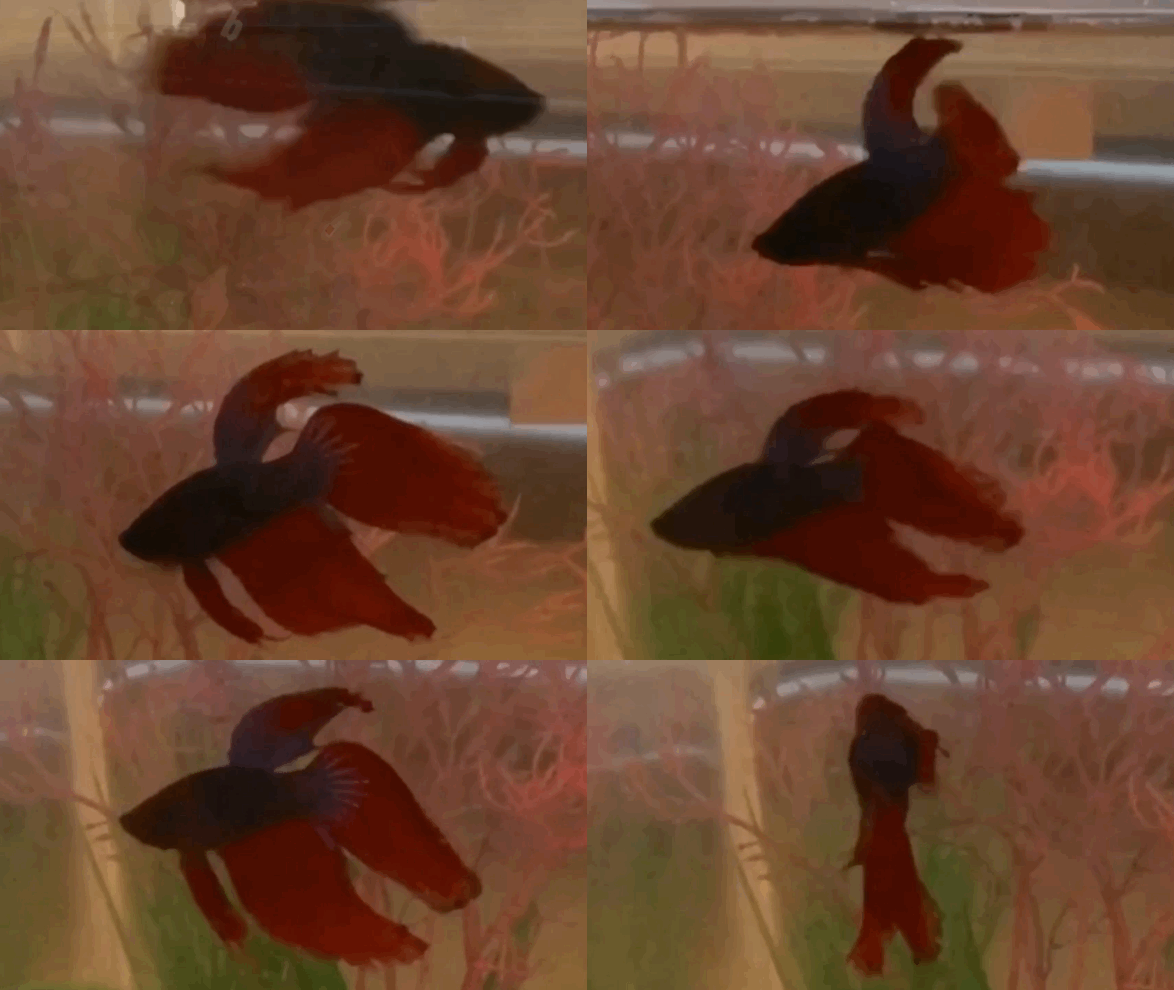
No. I figured your laziness would just kill your fish so took my buddy to the warehouse… I feel bad for leaving Red there for his possible death sentence but I wanted you to have a friend. If it was a dog or something I’d step in but it’s a $5 fish. Caring for an animal really helps guide your innards away from selfishness and neglectful ways. Which seems to be a pretty prevalent issue with your psychi. I took my dude with me because he looked like if he had a knife and clutches with opposable thumbs would slit his wrists. Remember kids.. It’s down the road, not across the street.

A tiny excerpt from my response:
“… Caring for a pet, caring for my property… If those things conflict with my friends and family, I neglect those things…”

JM’s full reply:

I understand what you said, but because of the hurt that’s inside you I see, maybe someday you’ll get why I got you an animal.

This stuff that’s unresolved that is repeating in your head and to other ppl, support groups internal/external unresolvable crutches are things that actually only you can resolve most times can be talked out best with a goldfish. Like forgiving yourself instead of asking for forgiveness from others around you.

The animals know basic instinct. Which is change. Life and Death. If you’re alive there always will be change. Change always takes time to adjust to, big or small. Death is your final change in this conscious form.

In the end it’s actually you talking to you and they speaking only with basics interprets of their known world. Superior in their own way. Because their interpretations are a manifestation of an answer in its own self as an entity.

If a picture says a thousand words, how many words are in a single action?

Plus.. if you kill someone, you can tell them where you hid the body and get it off your chest. They literally rip each other’s jaws off over [a mate] plus don’t speak English. No judgement there.

I’m caring for Red as lovingly as I can now. Occasionally, I watch him for a bit. Someday, I may speak to him (to myself).

Countless people have done beautiful things for me throughout my life. My life rolls on, changing always in this conscious form, with another beautiful friend I can count on… And then there’s JM, too…

.

Neil D. 2020-09-28

Racism, politics…


There should be no doubt that political movements are a mix of good and bad. Because PEOPLE are a mix of good and bad. Every single PERSON is a mix of good and bad. I, and you.

I am a racist. You are a racist. Every person on both sides of the racism divide is a racist, aren’t they? And almost everyone of us likes to talk in sweeping generalizations, and reject labels that point to our weaknesses. Every spectrum can be divided into infinitesimal parts, and in the realm of racism, I contend that even a single person falls at different points on that spectrum, depending on the question or the moment.

Racism hurts most by denial. If you deny your own racism, it’s certainly easier to be dismissive about systematic racism. I grew up in a completely white town and school. More diverse environments are less familiar to me. I cannot be blamed for that. But I can be justifiably blamed for hardening my heart defensively in conversations involving these larger issues.

The following kind of remark is wholly consistent with my background, but think about its potential impact on someone else: “I’m not a racist. I have a lot of black friends. I work with a lot of black people.” That might seems innocuously natural to some people, but it wounds the hearts of minorities, women, gays, etc. It’s a statement about your otherness, regardless of your intention. Eat some humble pie and let empathy rise up inside of you. It IS inside of you, and you can’t blame its suppression on your background.

Black people are different than I am. How different? For some, the difference is only skin deep. But without a doubt, for others, it is much, much deeper. The white man seated next to me is different than I am. For some, without a doubt, the difference is very, very deep.

Are your ego defenses really so important to you that you would risk alienating the fellow white man seated next to you? If you do offend him in casual conversation, now what is your excuse? “Sorry, I didn’t know you are gay, a recovering alcoholic, an ex-con, a person who just lost his child, a sexual abuse survivor,…”

I, and you, are a mix of good and bad. If you deny that, it’s certain you are dishonest. Even if you aren’t consciously lying, you have lied to your self. This is part of wisdom. There’s not a 50-year-old on the planet who can’t see through these lies, and that’s because middle-agers have told themselves many of the same. We won’t blame you for things about which you are blameless. And many of us won’t even blame you for things about which you are culpable—IF you drop the denial so that we can see your actual goodness hidden behind your artificial anti-badness walls (“I’m not a racist”).

If this kind of consciousness is new to you, here is just one suggestion I offer for cultivating it:

https://feelwithneil.com/2020/05/20/love-is-not-a-noun-3-to-love-is-to-be-curious/

.

Neil D. 2020-09-20