I reject the label of Trump supporter or Republican. I have a dare for you: BEFORE you *read* anything about the unscripted Macron meeting in the Oval Office, watch the FULL video coverage:
DON’T search for the video either, because you’ll see headlines and excerpts if you do.
These unscripted gaggles are remarkable to me.
The point here is to see no media biases before you watch it for yourself. After that, then do searches and compare what you saw versus the headlines about it, with critical thinking. If you’re anti-Trump, don’t worry – you’ll easily find headlines that smack of bias, because that’s how algorithms work: They’ll feed you what you always see – hatred and violent speech that darkens any hope or optimism, which is the intentional structure of the old-order relationship between the press and the body politic. Negativity sells because we each have an evolutionarily hard-wired bias toward the negative. You (nor I) are an exception – it’s not voluntary. It’s scientifically factual.
It’s hard to be politically optimistic if you do not spend your politics time viewing the raw source of information from this administration. I appreciate that watching a 40+ minute video takes more time than reading a biased written article. But I encourage you to do it anyway, instead of spending your time being mindlessly fed algorithm-selected memes and headlines and liking them and forwarding them to fortify your status within your tribe. You do recognize that is pure egocentrism, right?
We are quick to blame the tribal polarization that has divided previously tight-knit American families on Trump and his supporters. The sister at the Thanksgiving table wants her brother to be fed the same algorithm-selected propaganda. The Dunning Kruger effect tells us that we tend to think we are above average. Which of course means no one is average!
Today, the average person has their ego satisfied by mindless advocacy shaped by propaganda and media-feed algorithms. Let’s call lazy what lazy is, and take some honest time in an effort to see the world from the opposite bias. Try it. You might think it’s hard if you haven’t tried it, but it isn’t. It doesn’t take more than 24 hours for your feed algorithms to serve up the opposite bias propaganda. What a wonderful tool to appreciate how average we are. But it hurts, because we can’t avoid also realizing how stupid we were to argue with a beloved relative at a feast.
But take heart in being average, because the people you may have alienated are likely average also. Once you gain some dominion over your own hyper-emotional reactionism to biased propaganda, reconciliation becomes not only possible, but likely. “Be the change you want to see.” It works for the average and the elite alike!
By Your freely-given grace that has seen me through all things, and always will, I will pour out what You have filled my heart with, in the staggering certainty of faith.
When the anxious, fearful, and ashamed Neil rises up in me today, as he surely will, fill me with grace to smile within, open my arms to him, and welcome him, because I adore him, as You do. What a magnificent child he is, as Yeshua has shown me by grace. I and You will make him ok, as I and You make everything not only ok, but good and wonderful.
Throughout this day, show to my unworthy eyes the face of the Sacred Heart on everyone and everything I meet – including, and especially, when I greet the enemies of the perpetually-forgiven and always-beloved Neil.
My heart overflowing in certainty of Your Love knows it will be so, because You walk with me, Emmanuel. Amen.
.
Neil D. 2024-12-13
We all suffer. You are suffering. Many currents in our culture see suffering as a problem that needs solutions and fixes. I do not agree. As logical as that might seem to some people, I suggest that logic is very, very ill. And it makes us more ill – mentally, literally – and spawns more suffering. It is not at all logical to think that suffering requires any solutions. Nor that all suffering even *has* solutions.
One great thinker (and actor) suggested that to suffer willing is a supreme act of love. When we undergo suffering but want to fix it or escape it, we are not undergoing it willingly. Unwilling suffering is equal to our collective notion of what hell means.
Another supposedly great thinker called lovingly suffering the “opiate of the masses.” I don’t think he was a very great thinker at all. I rather think he was an emissary from hell. And today’s postmodern neo-Marxists are deputies of Satan who would have us believe that we suffer because it is our victimizers who are evil. Isn’t that a nifty trick? The great deceiver can never deceive greatly unless the deception can be easily mistaken as truth.
What logic *actually* shows us is that every attempt at fixing suffering causes more. Logic shows us how effortlessly easy it is to cause more suffering – infinitely easier to cause more suffering than it is to endure the suffering that is given us to endure.
“What we fail to transform, we transmit.”
Every time and way you willingly take on the suffering that has been specifically dealt to you is an act of profound and supreme love.
That is why suffering is so excruciating!
Yours is yours alone. Therefore cannot actually be shared. You yourself must “take up your cross”; no one can substitute for you. You’re an essential stitch in the fabric of reality. If you abdicate your responsibility for your own cross, you transmit that suffering onto others. Supreme and profound love is merely acting out all you can be.
If you are convinced that suffering is a condition that you should fix, or escape, go ahead and try, and tell me if it doesn’t deepen.
We are not made to fix or escape all suffering. It is not our nature.
To live in harmony with others – it is plainly logical to see – requires and demands suffering in some forms.
Is this not entirely clear to you? Think on it honestly until it is. Every act of authentic love that you have ever performed is necessarily an act of sacrifice. And what is sacrifice, except undertaking suffering willingly?
No sacrificing in the world, no suffering in the world, no love in the world.
Every act you have performed to alleviate suffering in the world amounts to sacrificing something of yourself. You may not consider such sacrifice to be the same as suffering. That’s your perspective or delusion, but it doesn’t mean that not every sacrifice involves suffering.
The greater the willing sacrifice, the greater the willing suffering, the greater the willing love.
So, I don’t wanna hear any more about God wanting us to be happy. God didn’t make us to be happy. That is not our nature. God made us to love and to be loved. That is our nature. And until you can equate happiness with suffering, love will be something you try to find, how? By fixing and escaping? You think that a path toward love? Is that really your experience of love? Does that seem logical, rational, reasonable?
To find the deepest goodness, fix and escape badness? No wonder depression and anxiety are rampant. We seek an out from the human condition because that condition involves suffering. How does that make more sense than the truth that our human nature is to love and therefore involves suffering?
To say that the truth has been revealed implies that it was so completely hidden that it could never be found lest it be magically revealed. I don’t know why those ideas are linked. It is not at all logical. We cannot come to know something that we are incapable of knowing. If we can know it, it is because we are capable of knowing it.
The revelation that profound love involves profound suffering wasn’t something we didn’t know. Deep down we knew it and know it. It was just something we didn’t *want* to know – something we didn’t want to be true, something we wished weren’t true. In that sense, what was revealed is how deeply we didn’t want to know it. How deeply we wished love could be free of suffering.
I’m not sure there is possibly a deeper revelation than awakening to our lies to ourselves. The fantasy of loving without suffering is one all of us hold. Just as all of us carry shame, self hatred, and many other delusions opposing truth. We easily buy the story that we are trash and therefore require a savior who can distract his father so his father doesn’t notice how wretched we are. What a horrible, horrible distortion of the greatest love story ever. Because we persistently wish for love without suffering, our thick skulls required divinity itself to show us they are the way. Love and suffering are bedfellows. A truth inescapable even by the divine.
Wish away. That’s not the truth.
Pick up your cross and love shall be yours. You already knew that.
My beloved has a friend with breast cancer in need. My beloved appeals:
“Dear Friends and Family,
This is one of my oldest, dearest friends. I have known Amber since first grade. She is battling the toughest fight of her life. I am reaching out because she is in desperate need of help. Life is kicking her ass right now. I am asking for prayers and donations. About a year before her diagnosis, she separated from her husband. She moved into an apartment with a roommate who left shortly after her breast cancer diagnosis. She has been living in an apartment with only the essentials. No furniture to speak of. She took a job in a textile factory working the night shift on an assembly line. It’s a good job but there are times that she is too sick from the side effects from her chemo treatments to work. She recently tried to move to a smaller apartment. She cannot move in until their pest problem is under control, so she is in between homes right now. This summer, she was in a car accident. She was hit from behind and her car was totaled. Amber’s mother is ill, but is doing her best to help take care of her when she can. Her father was a Penn Hills police officer who died of cancer 20 years ago. Amber has a son, Zachary, who recently became a father himself to a sweet baby boy named Knox. She also has a daughter, Zoe, who holds her hand when she is sick. Amber is tough and proud, and I have never known her to ask for help. So I’m asking for her and with her. All prayers and any donation will help. I am sending this to everyone I know and ask that you do the same. Please, please, please pass this on. Much thanks and gratitude.”
The deepest and most insidiously profound evil is the evil that best masquerades as goodness. It seems “good” to “count our blessings.” It isn’t. It’s evil. It is how The Father of Lies is so successful at deception and bankrupting human souls. By appealing to that which is not good or bad in itself, but which we all have as necessary to our existence as unique individuals. Comparison is its fuel, and the engine is
Ego.
…
‘Count your blessings’
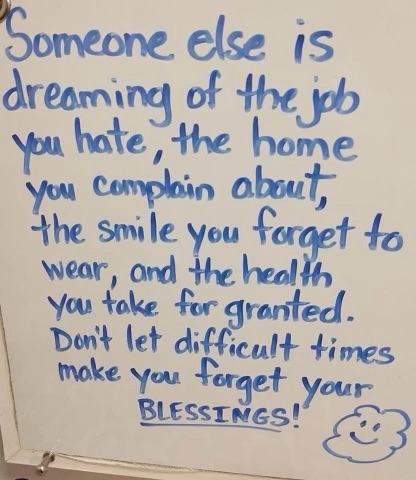
I can understand how this meme might be “positive,” to inspire practicing an attitude of gratitude, especially to someone with an ‘external locus of control’ and tendency to compare.
Soothing the low feelings of sadness to uplift a deflated ego.
I can see its appeal as a first step in therapeutic recovery, but, I have to call bullshit. It’s a mindset that can keep one stuck in the superficial early steps, because, spiritually, it is abominable – as is any therapy that manipulatively neglects the human spirit in favor of ego appeal packaged as self-esteem.
It horrendously encourages development of a superiority complex as a privileged class. Can you see how profoundly offensive this is to the “someone-else” dreamer? So how can it be anything except codependent on materialism and spiritually bankrupt?
Authentic gratitude is never, ever based on comparison.
How perverse is it to be thankful we’re not as bad-off as someone else? We are blessed because God favors us over them. The evil horror of “prosperity gospel.”
That’s nothing more than a manipulative mindfuck to elevate one’s ego above one’s spirit.
Authentic gratitude is, therefore – I contend – much rarer than the average person appreciates.
Average notions of gratitude reek of this false, ‘comparison’ flavor. An external locus of control means, quite simply, that we value our self only by the standards which others erect. That’s a fancy way of saying “comparison” – which isn’t only unhealthy, but spiritually evil, despite common reliance on it by our religious cultures, which are, in that regard, evil. It’s not just prosperity gospel preachers; it’s any dogma which suggests we merit God’s favor by what we do, to earn and deserve. It is why we get love so wrong. We are twisted by indoctrination and social conditioning to expect reciprocation of our good deeds and goodwill.
We are told in virtually every way of the world that this is how God loves, so why shouldn’t we? I need to improve so that God will love me more. So that my loved ones love me more. And my loved ones need to improve so that I can love them better.
Comparison is competitive egocentrism, and profoundly immature emotionally.
Yes, I appreciate that this criticism of the meme sounds extremely harsh on its surface. Yet I think an effective way to examine its fundamental wrongness is by deeply considering a sort of “survival guilt” evoked in response to not “counting our blessings” as the meme encourages. To illustrate, here’s a possible reaction to this meme:
“I try to practice an ‘attitude of gratitude.’ But sometimes I mourn all that I’ve lost.”
By the meme’s horrendous principle, this person who has suffered loss then suffers MORE – when they recognize their ingratitude. They don’t want to be like the “someone-else” dreamer. Shame on them for not being thankful for what they do still have, after their losses.
This evil “blessings” principle undermines and REVERSES the truth of authentic blessing and gratitude, of authentic grace. It is an untruth. Falsities never, ever serve and satisfy the human spirit. The human spirit accepts only honest truth, never denial. Only the ego accepts denial and untruth. That’s the currency exchanged when inflated egos seek control over deflated egos. It’s ego economy. Egology. Egonomics.
To “know” the deepest root truth, we must go to the deepest inner human “place.” Descartes fails us with, “I think, therefore I am.” The full human person also has the affective faculties of emotion – a form of knowing that’s both deeper and transcendent, at the same time.
The fullest truths we can “know” are by harmony of BOTH emotion and reason – never in conflict. This is why the blessings principle fails and is evil, and the false gratitude it encourages is not authentic. It preys on a dissonance between our logic (look how good you have it) and our low feelings, then preaches a privileged supremacy which rests on competitive comparison by logic, not love. It cannot be deeply true. It can only be relatively true. Comparison means “relative to.”
It’s not surprising that, since most of us get love wrong for much of our lives, most of us get gratitude wrong. When memes like this one dominate the landscape of common therapy, we shouldn’t be too ashamed that we don’t actually “know” what authentic love and authentic gratitude are. If you think that assertion is exaggerated, I remind you about the state of marriage in western culture, and drop the mic. Your objection ain’t got a leg to stand on.
…
Descartes sought to exclude relative truths and arrive at absolute truth, and bound himself to do so by ‘pure’ reason, without relying on emotions, of course: Reason is outside the realm of emotions. See the untruth here? We ARE beings with BOTH – logic and feelings.
When philosophical logic is ‘escalated’ to exclude the fullest human experience of being… well, it cannot serve the full human being. For thousands of years, philosophers have tried to excise our wonderful powers of reason from the drives of our body. Of course, every such attempt is bound to fail. Our mind is not separable from our body! This is how we are made. Those efforts are entirely artificial, and so, not surprisingly, of very little service to the human being with mind and body, brain and heart, ego and soul.
(If you’re interested in more about the mind-body question, I suggest you google cognitive scientist and philosopher David Chalmers; you can watch “closer to truth” YouTube featuring him for brief glimpses into his thoughts on updating the Cartesian philosophy of Descartes and mind-body dualism. For another modern scientific angle, find the current thought of Donald Hoffman on YouTube.)
What is wonderful is that Descartes did arrive at the deepest ground of authentic gratitude, grace, and blessing:
“I am.”
This profoundly deep and absolute truth litters both biblical testaments. Medieval theologian Thomas Aquinas describes God as “being itself.” In the evil blessings meme, what does the speaker have in common with the ‘someone-else’ dreamers? Being. What’s the last name of every Human Being?😉 At the absolute ground of a human being is being.
Nonbeing is, of course, the deepest fear of being human. Biological death is equated to nonbeing when one excludes the deepest and fullest experience of being human, which includes the human spirit. In this regard, materialistic atheism is not a fully human belief, and so of course must be spiritually dissatisfying. It is “rationalism” and “materialism” and is not far afield of three millennia of philosophers artificially dreaming that our spirit is our mind separated from our body.
(If you don’t think Pharisaic Judaism and the legacy of Yeshua the Nazarene added anything new to that conversation, I gently encourage some real study.)
Authentic grace requires understanding of unearned and undeserved gift. For us to count any blessings, the prerequisite is being. And being is a grace itself. We did nothing to deserve or earn being. Therefore all which follows from being is grace, in no complicated sense whatsoever!
Our ego wants to believe that we earned or deserve our job, home, etc. If we lose those, it is the ego which mourns those losses only because it believes those possessions were earned or deserved. When we know in the fullest sense that we *can* know – as human beings being human – we know that is not true. It is not the ‘Lord’ which “giveth and taketh away”; it is this mortal world, this biological realm, in which our being currently is. Our ego, for now, feels only at home according to the ways of this world.
It is the ego which suffers when we mourn loss.
It, too, is the ego which can be consoled by a false attitude of gratitude.
We did nothing to deserve or earn being.
We can be authentically grateful for being, itself. If we also understand our job, home, etc. to be grace – undeserved and unearned – we can be authentically grateful, and do not have to have any sense of “survival guilt” for a gift we have not earned.
When we “lose” something we have not earned, is it truly a loss?
When we most fully and truthfully are present, living in the now, abiding in the moment, we of course have no awareness of our possessions. That’s what authentic happiness is. The average person knows this, yet lives in ignorant denial.
The average person knows plenty of materially wealthy people who suffer unhappiness. Our brain tells us possessions are not a key to happiness, yet we lie to ourselves and console ourselves by status and possessions. And we always will – each time we cannot displace competitive comparison by authentic gratitude for the grace of being.
We can’t build authentic gratitude unless the foundation of that building is also true gratitude for merely being.
We know this to be true when we more fully “know” by all of what we are.
Sadly, we have been conditioned to deny this easily knowable truth, to rely on our ego rather than our fullness. Unlearning that conditioning, unknowing falsities, is a monumental challenge. But therapy must lead there, or it’s not only false, but evil.
The human heart can never be satisfied by a bad means to a good end. You’re bigger than that.
We’re each bigger than anyone can grasp in any moment.
Practice at remembering that deepest truth is pretty therapeutic.
Richard Rohr’s Daily Meditations for February 18-23, 2024 focused on “Life as a Spiritual Journey” (Weekly summary).
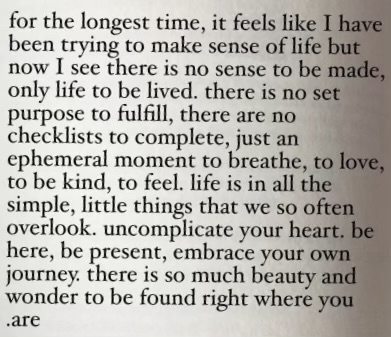
This passage from another source was shared with me during the same week.
Here are my somewhat strange reflections on both, as a springboard into Rohr’s readings.
If you’re in pain, I know you don’t want to be there. But it’s important for you to hear gently, you must.
If you crave and cling to positive platitudes, I understand. But it’s important for you to hear gently, you can’t.
If you believe you can chart your path toward healing, I wish you could. But it’s important for you to hear gently, you cannot.
If you believe you will emerge from suffering by doing things right, it’s important for you to hear gently, you are wrong.
If you think you have succeeded at healing from your pain, it’s important for you to hear gently, you have failed.
I do not know why, but it’s certain to me that sojourners who have passed through an authentic spiritual journey have all of these things you seek. In the presence of these people, you sense a calm. They have no compulsion to tell you their story, and they will never tell you that you have been wrong. That is not their language anymore.
*Their* language is *listening*.
Picture yourself in the presence of one of these calm and calming heroes who have returned home after their journey. You ask them a “big” question and await their wise answer. They may pause, smile, sigh… They gather themselves, because they were distracted. By what? By YOU. They were listening to you so deeply, it takes them a moment to realize they have been asked a question.
And, most often, they do not answer. Not really. Not in the same language that you asked your question. How can it be that they were so engrossed in you, in your presence, that they were not preparing an answer for your question as you spoke? Their answer to your question is their listening. Quite a paradox…
You sense a calm in their presence because they “live” in a much larger world. As you spoke, they were living with a much larger You than even you are aware of. Everything in the world in which they abide is larger than you can yet appreciate. And yet, it is the same world as yours. It is the same You that you yourself are aware of.
These are not the authors of platitudes or self-help books. They share wisdom through the language of their Life. Their world is larger, so books won’t do. Their world is larger, so answers won’t do. Already they know that you are failing, that you are wrong… For they also know that they are failing and they are wrong, but they are not obsessed or concerned with it, or fearful about it, as you are.
They do not wish to withhold any answer from you. Nor do they judge that you cannot grasp some profound wisdom they would offer. That doesn’t occur to them. That’s why you feel calm in their presence. And that’s why *they* feel calm in *Your* presence.
As You share in their world – their Life – by their listening to you, you too sense the larger You who lives there. And the “there” is not somewhere else. It’s right here. Your “big” question attempts to take them elsewhere, and that is why they have paused. Through their journey, they have long lost interest in elsewhere, and are whole, right here. Wholly here, and holy here.
Life is no longer about them. They are about Life. Their presence is soothing because they have a life energy, unleashed by nothing they have done, but, rather, by work that has been done on them.
 Feel with Neil