
As a single weed grows meekly amongst wildflowers
Seen as a threat,
Accused of stealing,
Not belonging,
Attracting enemies,
Destroying others,
Looking unsightly,
Being a burden,
But this particular weed is simply a tame plant
demonized by reputation of supposed comrades
that had no place in the life of the weed itself.
Pride is tricky. Best a mystery of love
There is a dark side to pride. Even pride in our child. Every child wants their parents to be proud, but why?
Pride is tricky. Perhaps pride in the good sense is a love or happiness for someone beloved to us.
When a child behaves badly in the presence of others, a parent feels shame. That arises from the ego because we think of the child as an extension of our self—a reflection of the values we impart to our child, and its negative judgment in this instance. Isn’t that a flipped peril of pride? When we are proud of their accomplishments, are we also proud of ourselves in that sense?
Should we take pride in our work? It is a common ideal to give all credit to God, but there is a saying attributed to St Augustine, something like:
With God, we can; without us, God won’t.
And so indeed there is a sense in which we bear responsibility for all that we do, including opening ourselves to God. Should we be proud of that? I suppose so, in a careful sense. If we believe we have the freedom to choose, and we choose righteously. But I think that too is ripe with danger.
I do believe that individuals have freedom, but I also believe it is irresolvably mysterious for each. We are products of our past back to birth, and even beyond birth by the gently shaping hands of evolution. Just as no two individuals have the same DNA, no two individuals share the same life experiences that shape their emotional responses and states.
In the same person, childhood freedoms differ from adult freedoms. And surely we would not ascribe the same freedom to a victim of mental disease as we would to one less afflicted.
Is this question of pride a question of balance? Of moderation? As long as the ego remains “properly sized” in relation to the soul, perhaps the ego cannot help but feel some pride. The ego is our sensor that we are an independent agent in creation. Is pride its form of self-love? Is self-love not good? I think that self-love is good. I think that loving another is limited to an extent that self-love is limited, so self-love cannot be bad.
I like to think of ego as a child that needs the loving embrace of its soul. It’s OK to be proud of ourselves and proud of our children when that pride is an expression in the voice of the ego submissive to its soul. As if, in embrace, the soul whispers to its ego, “Thank you ego for making that happen.”
With soul, the ego can; without ego, the soul won’t.
Yes, pride might be as far as ego can go on its own. And it seems that should be OK. It is one of the countless forms of love. And as long as love is situated in the realm of mystery, it is authentic.
I think a mysterious realm of paternal pride is spoken of in this song:
https://feelwithneil.com/2020/06/21/thundering-velvet-hand/
Neil D. 2020-06-24
Thundering velvet hand
He earned his love through discipline, a thundering velvet hand
His gentle means of sculpting souls took me years to understand
…his blood runs through my instrument and his song is in my soul
My life has been a poor attempt to imitate the man…
[No, my life has NOT been a poor attempt to imitate my Dad. I don’t believe “imitation” was ever his wish…]
I thank you for the freedom when it came my time to go
[He sculpted my soul to be my own. No one else’s. So that when I did go, I would be ok.]
I thank you for the kindness and the times when you got tough
[His sculpting hands]
[I don’t believe he ever wished for imitation. Instead, his only wish:]
And papa, I don’t think I said I love you near enough
[I love you, Dad.]
[And we are OK. Rest in peace.]
Father’s Day 2020
“Love and acts of love are so profound because they are utterly original. They arise from a purely unique creator. YOU are unique. YOU are a creator. You do not need to imitate other creators or creations.” (source)
Angels In the Mist
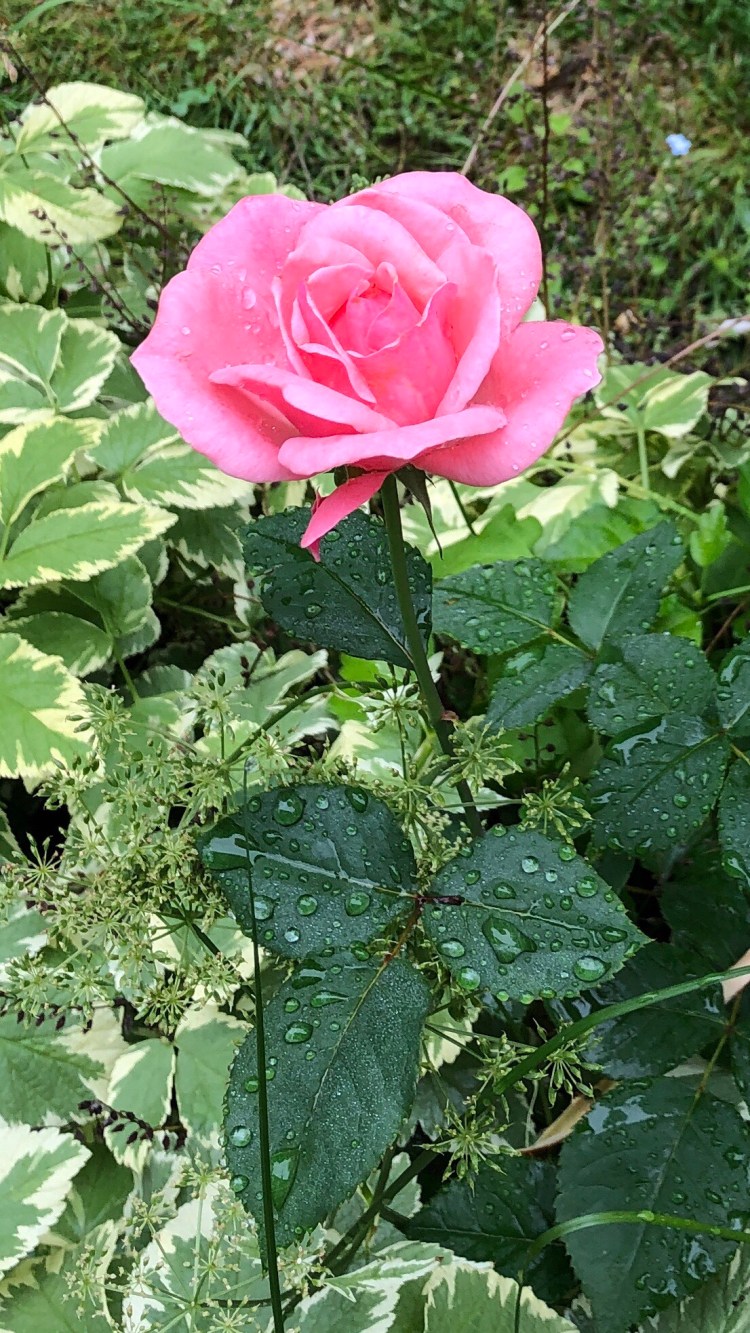 Hours earlier, these droplets formed out of the morning mist. Settled here, they endow even greater beauty to an already beautiful image of God’s presence in nature’s cathedral. On this altar, these droplets are separate, yet from, and of, the same substance. The same essence. They will, hours from now, be transformed, imperceptibly, still the same substance. Mist has so many forms…
Moments after this photo, an insect alighted on a pink petal. I missed the shot, instead watching it lap a delicious droplet. It departed, the droplet smaller, but the mist’s heart enlarged, and its substance expanded to whereabouts unknown by a six-legged angel earlier drawn by a colorful and soft and fragrant fountain, I having enjoyed a glimpse of life’s circle that enfolds us all magically by one common Mistery
Neil D. 2020-06-20
Protected: The Sometimes of Individual Freedom: Treatise on Soul
A response to religious bribery (corruption)
It’s deeply interesting to me that the religious corruption cited here is largely, to me, indeed a corruption of religious traditions themselves, and by the most visible/vocal religious adherents themselves. This is what gave rise to Nietzsche’s announcement that, “God is dead.” And it is the corrupt God-following zealots who killed God—who corrupted the wisdom on which the greatest traditions were built.
To me, it is a misrepresentation of perennial wisdom traditions to say that they are founded on bribery. But it’s not unfair to say that that is how those traditions have been corrupted. What I mean is that the best of these wisdom traditions do not have at their heart a message of asking God for what one wants. Instead, they are rooted in the surrender of those wants and the discovery of a loving contentment with who one is, and what one has, already.
I’ll also offer partial agreement to the notion that the most religious youths grow up to be the most corrupted, in terms of their attempts at bribing God. Only partial agreement, because if those zealots continue growing, typically into middle-age, they are made aware of their own corruption in various ways. These authentic wisdom traditions hold up very, very few heroes who came into their own before middle-age. As success is built on failure, love is built on suffering. One must suffer enough before one knows what authentic love is. And only to the extent that one knows authentic love can one know God, uncorrupted. Within one’s soul.
 Feel with Neil